


How Generative Media Tools Are Reshaping Artistic Practice?
The intersection of generative artificial intelligence (AI) and creative expression marks one of the most profound shifts in the cultural landscape of the early 21st century. Generative media tools—ranging from image and video generators to text-to-image models like Midjourney and Stable Diffusion—promise artists, designers, and creators unprecedented access to complex visual and audiovisual production. These systems operate by learning patterns from massive datasets of existing artwork and media, then synthesizing outputs based on statistical correlations in that data. This raises fundamental questions about whether these tools represent an expansion of artistic creativity or a form of aesthetic mimicry that undermines longstanding artistic traditions. Scholars and practitioners alike are debating whether generative AI constitutes a new creative collaborator or simply an advanced copy machine that reproduces existing work under the guise of innovation. [1]
Generative AI’s technical foundations blur the line between novel creation and replication. These tools are not autonomous creators in a human sense; rather, they draw from patterns embedded in data collected from millions of existing works of art. As one analysis of modern generative models explains, these systems can reproduce diverse artistic styles while maintaining structural and compositional coherence, often yielding visually convincing results that echo artistic traditions from Renaissance portraiture to contemporary digital abstractions. The synthesis of stylistic elements is at the core of both the enthusiasm and unease surrounding these technologies: proponents see them as expanding the creative palette available to humans, while critics see them as derivative processes that replicate aesthetic forms without genuine originality.
The debate over whether these outputs qualify as “art” exposes deeper tensions about the nature of creativity itself. In human creative practice, artists reference and build upon prior works, traditions, and cultural contexts; art history is replete with movements where forms and themes evolve through reinterpretation. Against this backdrop, defenders of generative AI argue that these tools extend this lineage rather than break it, enabling creators to explore ideas at scales and speeds previously unimaginable. Users can generate thousands of variations on a theme, refine visual motifs, and experiment with configurations that might otherwise demand extensive manual effort. From this perspective, AI tools act as collaborators—albeit non-sentient ones—amplifying human imagination by providing new generative capabilities that feed back into human decision making and refinement.
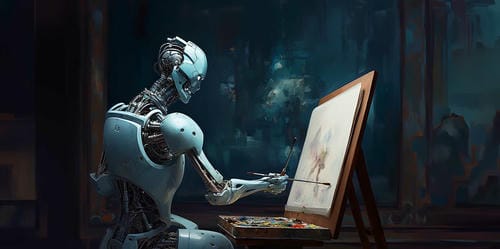
However, critics challenge the legitimacy of such claims by highlighting key structural concerns. Because generative AI systems are trained on datasets that often include copyrighted works without explicit consent or compensation, there is a significant ethical question about whose labor and creativity underpin the outputs. Artists have voiced frustration that their own work, shared online over years, serves as the raw material for models that now produce derivative content at digital scale. They argue that this dynamic effectively appropriates human creativity for commercial gain while relegating original creators to the periphery, often without acknowledgment or remuneration. This tension came to a head in legal actions, such as lawsuits filed by major media companies against AI firms over unauthorized use of copyrighted characters and visual trademarks, underscoring how generative tools can function less as artistic partners and more as engines of replication that infringe legal norms. [3]
Beyond legal and ethical disputes, there is also an artistic concern about the homogenization of aesthetic expression. Generative tools tend to produce outputs that reflect dominant patterns in their training data. When models are heavily biased toward certain cultures, styles, or visual traditions, the art they generate can reinforce a narrow canon at the expense of diversity and cultural specificity. For example, AI models trained predominantly on Western art can produce work that unwittingly marginalizes non-Western visual traditions, effectively flattening the global artistic landscape into a series of familiar tropes rather than a vibrant plurality of voices. Such outcomes challenge the notion that these tools are inherently democratizing; instead, they can inadvertently perpetuate historic biases embedded within their datasets, substituting one form of canonization with another.
Amid these concerns, some segments of the art world have voiced outright resistance to integrating generative AI into creative production. Influential artists and industry leaders have publicly rejected the use of AI tools, emphasizing the primacy of human emotional engagement, intuition, and lived experience in authentic artistic expression. One such stance was articulated by long-standing creative institutions that resisted AI’s encroachment on traditional comics and visual storytelling, arguing that machines cannot replicate the emotional depth or contextual understanding that human artists bring to their craft. Furthermore, collective actions by thousands of artists opposing AI-centric art auctions illustrate a broader discomfort within the creative community, reflecting fears that generative AI not only replicates existing work but threatens to commodify and displace human artistic labor.
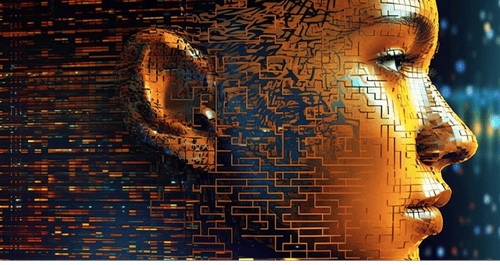
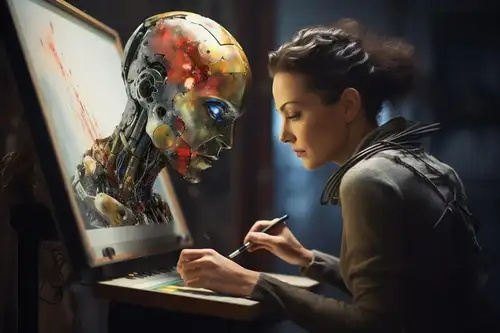
Yet generative AI has already demonstrated that it can move beyond simplistic mimicry to influence artistic practice in meaningful ways. Many creators have embraced these tools not as substitutes for human creativity but as new implements in a broader creative workflow. Projects that incorporate AI-generated imagery as conceptual scaffolding—followed by hand-drawn refinement or traditional media interventions—exemplify a hybrid approach where AI outputs serve as raw material for human interpretation. Such use cases underscore the idea that creativity is not solely a product of authorship but a dialogic process involving tools, traditions, and individual vision. [5]
This hybridization also raises questions about the evolving definition of artistic skill and craftsmanship. When generative tools are part of the creative process, artistic expertise increasingly includes the ability to guide, curate, and transform algorithmic outputs. Prompt engineering, iterative refinement, and post-generation editing are now essential competencies in many digital art practices. By contrast, some critics argue that equating these skills with traditional craftsmanship dilutes the notion of artistic mastery, rendering the creative act more about technological proficiency than expressive intent.
Underpinning all of these debates is the broader philosophical question of whether generative AI truly “creates” in any meaningful sense. Since these systems lack consciousness, intent, or subjective experience, their outputs are not creative in the way humans understand creativity—that is, as an expression of inner vision and contextual understanding. Instead, generative AI synthesizes outputs based on learned correlations, producing what some commentators have described as aesthetic pastiche rather than original insight.
Nevertheless, historians of art and technology observe that innovations that once seemed disruptive often become integrated into creative ecosystems in unexpected ways. Previous digital tools, such as digital image editing software, were once met with resistance before becoming integral to artistic production and visual culture. In this light, generative AI may represent not a rupture with tradition but an extension of the long evolution of artistic tools—a continuum where each technological advance recalibrates the boundaries of what art can be and who gets to make it.
The tension between creativity and imitation in generative AI is not easily resolved. It reflects enduring cultural anxieties about authenticity, originality, and value in an era where machines can approximate human productivity with remarkable fidelity. Whether generative media tools become engines of creative liberation or instruments of replication will depend on the evolving practices of artists, the ethical frameworks governing data and ownership, and society’s willingness to redefine the terms of artistic agency in a digital age.
Sources:
[1]: https://academic.oup.com/pnasnexus/article/3/3/pgae052/7618478
[2]: https://medium.com/%40fdonelli/generative-ai-and-the-creative-industry-finding-balance-between-apologists-and-critics-686f449862fc
[3]: https://apnews.com/article/disney-universal-midjourney-copyright-lawsuit-722b1b892192e7e1628f7ae5da8cc427
[4]: https://www.ft.com/content/e8c7b729-f87a-408c-a2be-76f8da489ba2
[5]: https://un-aligned.org/artificial-intelligence/more-than-a-mere-copycat-the-rise-of-ai-generated-art-and-its-implications
References:
https://academic.oup.com/pnasnexus/article/3/3/pgae052/7618478
https://kerson.ai/research/generative-ai-in-art-video-and-music-key-concerns-and-debates
https://manuelgarcia.designrshub.com/publication/artificial-creativity
https://www.theverge.com/news/797540/dc-comics-jim-lee-no-generative-ai-pledge
Recommended for you: